Insights
Overcoming Compliance Challenges with Ambient Air Monitoring
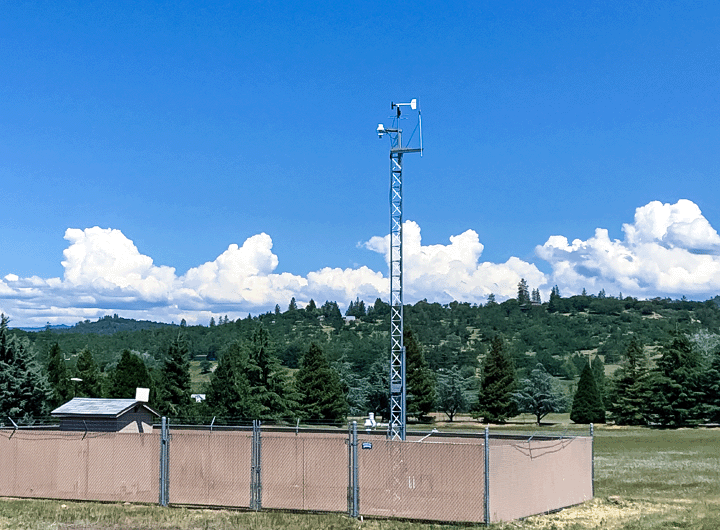
Curious as to whether your new emissions control technology is working as it should? Worried about meeting difficult regulatory compliance? Ambient air monitoring may be the solution for you. With capabilities such as meteorological, odor, fenceline, or traditional air pollutant monitoring, MFA’s ambient air monitoring services can help clients proactively get ahead of evolving regulations and enhance dispersion modeling results.
What is ambient air monitoring?
Ambient air monitoring involves collecting samples of outdoor air at specific locations of interest and evaluating them for concentrations of one or more regulated pollutants. Regulated pollutants can range from coarse (PM10) and fine particulate matter (PM2.5), to gaseous criteria pollutants (nitrogen dioxide, sulfur dioxide, carbon monoxide) and hazardous or toxic air contaminants (e.g., benzene, hydrogen sulfide, naphthalene). Samples are collected at regular intervals and can be used to evaluate the effectiveness of emission control strategies, track air quality trends over time, and help companies understand their pollutant emissions. This approach helps users proactively respond to regulatory concerns, maintain or reach regulatory compliance, and ensure community confidence. Coupled with meteorological monitoring, ambient monitoring can help identify:
- Locations with the highest monitored concentrations.
- Temporal variability in air quality.
- Weather conditions associated with the poorest air quality.
- Impacts from neighboring industry or background concentrations of pollutants.
What is meteorological monitoring and why is it essential to ambient air monitoring?
Meteorological monitoring follows the same processes as ambient air monitoring except that it focuses on collecting meteorological parameters (such as air temperature, humidity, and wind direction) to assist with determining how air pollution travels from its source. If your site is complicated due to a large number of buildings or unique geography, meteorological monitoring is essential. If a more technical analysis or atmospheric dispersion modeling are required, turbulence parameters (e.g., horizontal wind direction standard deviation, vertical wind speed standard deviation, eddy covariance fluctuations) can be collected. Together, air quality and meteorological monitoring provide a formidable tandem approach that can help you understand the air quality in and around your facility.
Using ambient air monitoring to get ahead of new regulations
As air quality is an ever-evolving science, state and federal regulators promulgate new and/or more stringent air quality regulations periodically to better protect human health. Some example air quality standards that have been recently updated or will be updated in the near term include:
- Hazardous Organic NESHAP (HON) Fenceline Monitoring Requirements (July 15, 2026)
- Revised PM2.5 Annual National Ambient Air Quality Standard (NAAQS) (2025)
- Oregon DEQ’s Short-Term NAAQS Compliance Initiative (2023)
- Cleaner Air Oregon (CAO) Air Toxics Program (2020)
- Washington’s Air Quality Standards in Overburdened Communities (Spring 2026)
Each of these programs have emissions and health-based standards that can curtail a facility’s ability to expand and/or achieve maximum operation if they are not met. Ambient monitoring is a tool that can be used to identify where sticking points might arise and get ahead of the problem.
Because regulatory agencies have specific guidelines that must be followed in order for collected data to be considered valid, it is imperative to follow certain procedures when evaluating air quality through ambient air monitoring. It is critical that you choose to consult with technical experts in the field.
Ambient air monitoring in the Pacific Northwest
MFA’s Air Quality team has a unique combination of skills and experience in implementing air monitoring programs throughout the Pacific Northwest. Our team includes air quality experts, meteorologists, industrial hygienists, instrument technicians, and data quality experts with experience monitoring hazardous air pollutants, toxic air contaminants, criteria pollutants, and odors. Reach out to our experts to learn how MFA’s ambient air monitoring services can help your company proactively respond to regulatory concerns, maintain or reach compliance, and ensure community confidence!
Meet the Team
Air Quality Experts at MFA




Contact Us!
Learn More About MFA's Air Quality Solutions
Reach out to our team for tailored air quality solutions!

Share this article on social media/email
Author